Is the Kebra Nagast Part of the Ethiopian Bible?
No. The Kebra Nagast is not one of the 81 canonical books of the Ethiopian Orthodox Tewahedo Bible. It is a highly influential Ethiopian religious and national epic whose title means Glory of Kings. It tells how Queen Makeda met King Solomon, how their son Menelik became the ancestor of Ethiopia’s Solomonic rulers, and how the Ark of the Covenant came to Ethiopia.
The book draws heavily on the Bible and holds enormous importance in Ethiopian Christian history, but religious importance does not automatically make a work biblical scripture. The official Ethiopian Orthodox canon list includes Enoch, Jubilees, and church order writings, but it does not include the Kebra Nagast.
Last reviewed 8 September 2026. See our sources and editorial standards.
The clear answer
The Kebra Nagast belongs to Ethiopia’s wider Christian literary tradition, not to the official list of 81 biblical books. That distinction is easy to miss because Ethiopian Christianity preserved far more than one collection of scripture. It also produced and transmitted histories, hymns, homilies, royal chronicles, theological works, legal texts, saints’ lives, and books explaining national tradition.
The Ethiopian Orthodox Tewahedo Church’s published canon list names 46 Old Testament books and 35 New Testament books. The Kebra Nagast does not appear in either group. The same church source separately recognizes a much larger world of historical and religious literature written in Ge’ez.
The Kebra Nagast is sacred history and national tradition, but it is not a book of the Ethiopian Bible.
What the Kebra Nagast is
Kebra Nagast, commonly translated as The Glory of Kings, is an Ethiopian work written in Ge’ez. In its surviving form, it contains 117 chapters and combines biblical interpretation, royal genealogy, legend, theology, political thought, and accounts of Ethiopia’s relationship with Israel.
Its central purpose is to explain the sacred origin of Ethiopian kingship. The book presents Ethiopia’s Solomonic dynasty as descending from King Solomon and Queen Makeda, the Ethiopian identification of the Queen of Sheba. Their son Menelik becomes Ethiopia’s first Solomonic ruler.
The work is more than a royal family story. It presents Ethiopia as an heir to the biblical covenant and connects the nation’s destiny with Zion, the Ark of the Covenant, and Christian faith. Biblical passages are quoted and interpreted throughout its chapters.
Modern descriptions often call it Ethiopia’s national epic. That term fits its broad cultural role, although it is written as an extended prose religious narrative rather than as a modern novel or a single heroic poem.
Why it is not part of the biblical canon
A biblical canon is a recognized collection of books received as scripture by a religious community. A work can be respected, quoted, taught, and copied for centuries without belonging to that collection.
The official Ethiopian Orthodox account gives a specific list of canonical books. It includes familiar books such as Genesis, Psalms, Isaiah, the four Gospels, and Revelation. It also includes works absent from Protestant Bibles, such as Enoch and Jubilees, together with a broader New Testament group connected with church order.
The Kebra Nagast is absent from the list. This is stronger evidence than modern websites grouping every famous Ethiopian religious text under the label Ethiopian Bible.
Important does not mean canonical
The Kebra Nagast has influenced Ethiopian religious identity, monarchy, art, and ideas about the Ark. None of that requires calling it a Bible book. Christian traditions everywhere preserve influential writings outside their biblical canons.
It is also not the Fetha Nagast
The similar names cause another common mistake. The Kebra Nagast means Glory of Kings and tells the Solomonic and Ark narrative. The Fetha Nagast, or Law of the Kings, is a legal and ecclesiastical work. Neither title should be silently inserted into the biblical canon simply because it is famous in Ethiopian history.
Why people think it is in the Ethiopian Bible
Several true facts are regularly combined into a false conclusion:
- It is an Ethiopian Christian book. The Kebra Nagast is deeply connected with Ethiopian Orthodox history and ideas.
- It uses biblical material. Solomon, the Queen of Sheba, the Ark, Zion, Israel, prophecy, and Christ appear throughout the work.
- The Ethiopian canon contains distinctive books. Enoch and Jubilees really are canonical in Ethiopia, so readers assume every unusual Ethiopian text belongs to the same list.
- Online sellers use loose language. Collections marketed as forbidden, lost, or complete Ethiopian Bibles sometimes include unrelated texts without explaining their status.
- English information is inconsistent. The larger Ethiopian literary tradition is complicated, and simplified lists often mix scripture, church order, history, and later commentary.
The result is a category error. Ethiopian religious literature is much larger than the Ethiopian biblical canon. The Kebra Nagast belongs to the larger library.
The story of Makeda, Solomon, and Menelik
The Bible describes a Queen of Sheba who hears of Solomon’s wisdom and travels to Jerusalem with spices, gold, and precious stones. She tests Solomon with difficult questions, recognizes his wisdom and prosperity, exchanges gifts, and returns to her country. First Kings 10 and 2 Chronicles 9 do not give her a personal name, describe a sexual relationship, or mention a son.
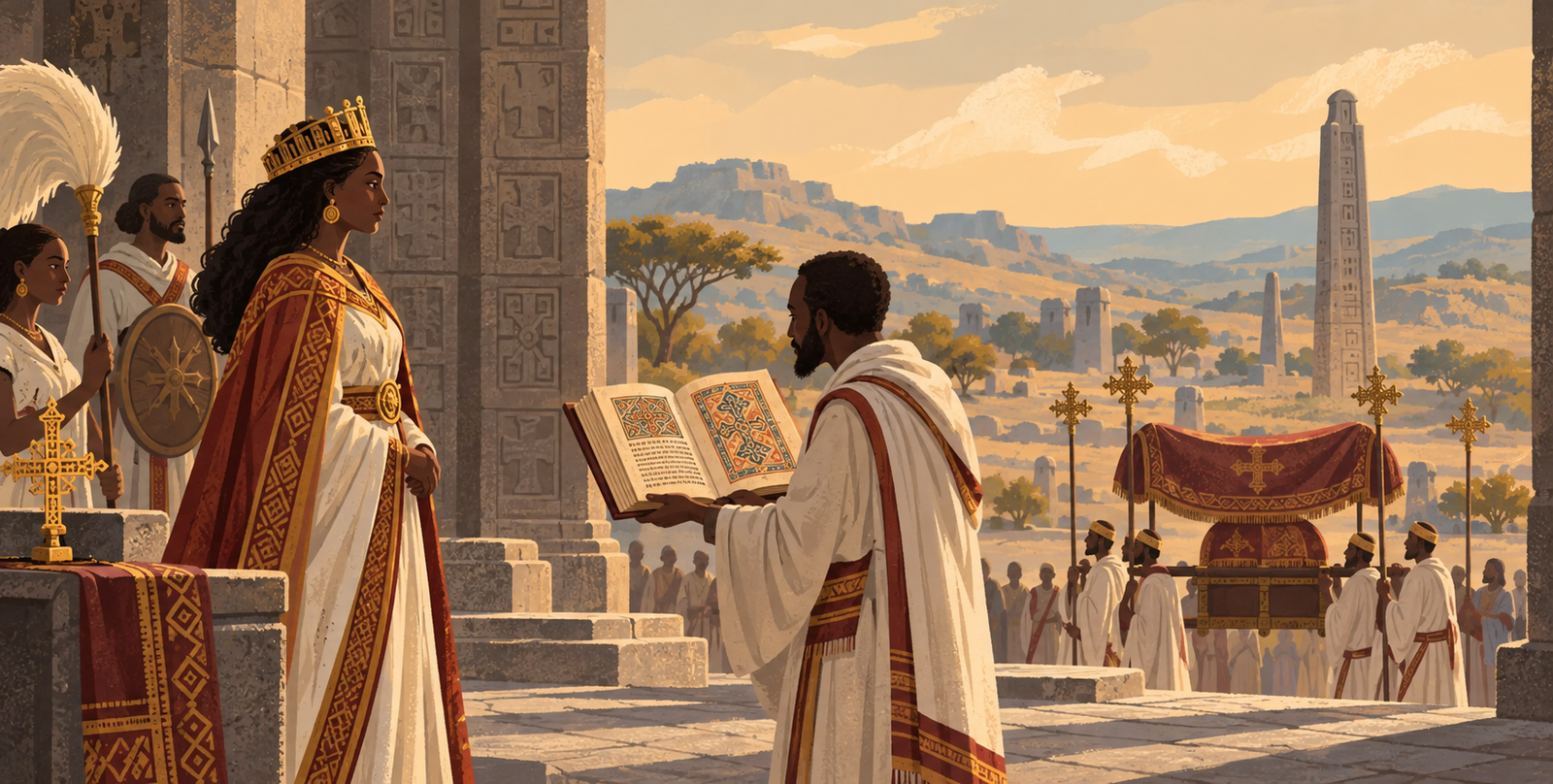
The Kebra Nagast develops a much larger story. The queen is Makeda, ruler of Ethiopia. She hears about Solomon’s wisdom from Tamrin, a merchant connected with her kingdom, and travels to Jerusalem. Solomon instructs her in the God of Israel, and Makeda turns away from the worship of the sun.
Before her departure, Solomon persuades Makeda to remain as his guest. The narrative describes an agreement involving food, water, and an oath. Through Solomon’s plan, Makeda breaks her side of the agreement by taking water during the night. Their union produces a son.
The son grows up in Ethiopia and later travels to Jerusalem to meet his father. He is known as Menelik, although the text uses forms such as Bayna Lehkem in the older English translation. Solomon recognizes him and wants him to remain, but Menelik chooses to return to Ethiopia.
Solomon sends the firstborn sons of Israelite nobles with Menelik. This transfer creates a new royal and religious community in Ethiopia. Menelik returns as king, and Makeda gives him authority.
What it says about the Ark of the Covenant
The Ark story is the most famous part of the Kebra Nagast. According to the narrative, the sons of the Israelite nobles do not want to leave Zion behind. Azariah, the son of the high priest Zadok, arranges for the Ark to be removed from the Temple and replaced with a copy.
Menelik initially does not know what has happened. Once the Ark’s presence is revealed, the journey becomes a sacred transfer rather than an ordinary theft in the logic of the story. The travelers understand that God has chosen to move Zion from Jerusalem to Ethiopia.
Solomon discovers the loss and attempts to pursue them, but the Ethiopian party travels with supernatural speed and escapes. The Ark reaches Ethiopia, where it becomes the foundation of the nation’s covenant identity.
The Ethiopian Orthodox tradition connects the Ark with the Church of Our Lady Mary of Zion in Aksum. The claimed object is not open to inspection, so historians and archaeologists cannot independently verify its identity or age. The Kebra Nagast remains the fullest literary expression of the Ethiopian Ark tradition, but its narrative is not the same thing as physical proof.
What the Bible itself says
The biblical account of the Queen of Sheba does not say that she married Solomon, bore Menelik, or carried the Ark tradition to Ethiopia. Those details come from later Ethiopian tradition as preserved in the Kebra Nagast.
When the Kebra Nagast was written
The surviving Ge’ez form is normally associated with the early fourteenth century. A colophon found in many manuscripts says the work passed from Coptic into Arabic and was then translated into Ge’ez by a group of Ethiopian clerics. Scholars debate how literally to take that account and how much earlier material lies behind the final composition.
A commonly proposed period for the Ge’ez compilation is between 1314 and 1322. This fits the political world of the restored Solomonic dynasty, which had taken power in 1270 and claimed descent from Solomon.
The book certainly uses older traditions and sources. Its biblical material is ancient, and stories connecting Solomon, the Queen of Sheba, and Ethiopia circulated before the fourteenth century. That does not make the surviving Kebra Nagast a work written in Solomon’s lifetime.
Some scholars have argued for earlier layers or a substantially earlier form. Others emphasize the medieval political setting and the text’s role in legitimizing Solomonic rule. The precise development remains debated, but describing the complete surviving work as a direct record from the tenth century before Christ is not supported by current manuscript evidence.
History, tradition, and modern scholarship
The Kebra Nagast presents its story as sacred history. For centuries it supported the claim that Ethiopian emperors descended from Solomon through Menelik. This genealogy gave royal authority a biblical foundation and linked Ethiopia’s monarchy with ancient Israel.
Modern historians study the work differently. They ask when its parts were composed, which biblical and nonbiblical sources it used, how it supported the Solomonic dynasty, and what it reveals about medieval Ethiopian thought.
No independent contemporary record confirms that Solomon and the Queen of Sheba had a son named Menelik or that the Ark was transferred to Ethiopia in their time. The long gap between the era traditionally assigned to Solomon and the surviving medieval text makes direct historical verification impossible.
That conclusion does not make the Kebra Nagast worthless. A work can be historically uncertain as a record of the tenth century before Christ while remaining extremely valuable evidence for Ethiopian theology, identity, kingship, and literature in the medieval and later periods.
| Claim | Kebra Nagast tradition | Historical assessment |
|---|---|---|
| Makeda | The Queen of Sheba was Ethiopia’s Queen Makeda. | The Bible does not name the queen or clearly identify her kingdom with later Ethiopia. |
| Menelik | Makeda and Solomon had a son who ruled Ethiopia. | No contemporary inscription or record confirms Menelik as Solomon’s son. |
| The Ark | The Ark left Jerusalem with Menelik’s party and reached Ethiopia. | The claimed object cannot be independently examined, and the transfer lacks contemporary documentation. |
| Solomonic dynasty | Ethiopian kings descended directly from Solomon. | The claim became a powerful basis of medieval royal legitimacy, but the ancient genealogy cannot be verified. |
| Date of the book | The work claims a chain of older language versions and sources. | The surviving Ge’ez compilation is commonly dated to the early fourteenth century, with possible older materials. |
Its importance in Ethiopian Christianity
The Kebra Nagast gave literary form to the idea that Ethiopia inherited Zion’s covenant. It connected kingship, nation, church, and the Ark within one sacred history. That framework influenced Ethiopian royal ideology for centuries.
The Solomonic claim appeared in the constitutional language of modern imperial Ethiopia. Emperor Haile Selassie belonged to the dynasty that traced its legitimacy through Menelik to Solomon. The monarchy ended in 1974, but the Kebra Nagast retained its cultural and religious significance.
The book also shaped international ideas about Ethiopia. Rastafari readers connected Haile Selassie’s Solomonic titles with biblical prophecy and treated the Kebra Nagast as an important witness to Ethiopia’s sacred place. Rastafari uses of the work, however, are not identical to Ethiopian Orthodox teaching.
Within Ethiopian Christianity, the work supports traditions surrounding Aksum, Zion, covenant, and royal history. It is best described as a revered religious and national text rather than as an additional book inserted into the Bible.
How it differs from Enoch and Jubilees
The clearest way to avoid confusion is to compare the books directly:
| Book | Main subject | Approximate setting of composition | Canonical in Ethiopia? |
|---|---|---|---|
| Kebra Nagast | Makeda, Solomon, Menelik, the Ark, and Ethiopian kingship | Surviving Ge’ez compilation commonly dated to the early fourteenth century | No |
| 1 Enoch | Watchers, heavenly journeys, judgment, visions, and wisdom | Ancient Jewish collection from the centuries before and around the beginning of Christianity | Yes |
| Jubilees | Genesis and Exodus retold through covenant, law, angels, and sacred chronology | Jewish work normally dated to the second century before Christ | Yes |
Enoch and Jubilees appear on the Ethiopian Orthodox Old Testament list. The Kebra Nagast does not. You can explore the canonical works through our Book of Enoch guide, complete Enoch reader, and Book of Jubilees guide.
Reading the Kebra Nagast in English
E. A. Wallis Budge published the first complete English translation in 1922 under the title The Queen of Sheba and Her Only Son Menyelek. It is now widely available in scans and public domain transcriptions.
Budge’s translation made the complete work accessible to many English readers, but its language is old and its editorial approach reflects scholarship of its time. Newer translations and academic studies may offer clearer language and more current analysis.
Readers should check what an edition contains before buying it. Some modern books shorten the narrative, modernize the language without explaining changes, or combine the Kebra Nagast with unrelated texts. A cover using the words Ethiopian Bible does not prove the Kebra Nagast is canonical.
For reliable information about the actual canon, start with the complete 81 book list. For English translation limits and misleading product claims, see which Ethiopian biblical books are available in English.
The accurate conclusion
The Kebra Nagast is one of Ethiopia’s most influential books, but it is not part of the Ethiopian Bible. It belongs to the wider religious, historical, and literary tradition surrounding the Ethiopian Orthodox world.
Its importance comes from the story it tells: Makeda’s meeting with Solomon, the birth of Menelik, the arrival of the Ark, and the sacred origin of Ethiopian kingship. These themes shaped national identity and royal legitimacy for centuries.
Calling the work biblical scripture blurs an important distinction. Enoch and Jubilees are unusual books that really do belong to the Ethiopian canon. The Kebra Nagast is a later Ethiopian interpretation of biblical history whose authority and influence developed outside the canon.
The Kebra Nagast explains how Ethiopia understood its place in sacred history. It is not an eighty second book of the Ethiopian Bible.
Sources and further reading
- Ethiopian Orthodox Tewahedo Church, Canonical Books. The official published list of 46 Old Testament and 35 New Testament books.
- Gizachew Tiruneh, The Kebra Nagast: Can Its Secrets Be Revealed? A scholarly discussion of the text, its chapters, and its historical claims.
- Stuart Munro-Hay, A Sixth Century Kebra Nagast? Research on the date and historical materials used by the compilers.
- Columbia University World Epics, Kebra Nagast. An introduction to the work and its Solomonic political setting.
- The Kebra Nagast, translated by E. A. Wallis Budge. Public domain English reading text.
- 1 Kings 10:1 to 13, King James Version. The biblical account of Solomon and the Queen of Sheba.
Frequently asked questions
Is the Kebra Nagast one of the 81 books?
No. It does not appear in the Ethiopian Orthodox Tewahedo Church’s official list of 46 Old Testament and 35 New Testament books. It belongs to Ethiopia’s wider religious and historical literature.
What does Kebra Nagast mean?
The Ge’ez title is commonly translated as Glory of Kings or Glory of the Kings. The work explains the sacred origin and authority of Ethiopia’s Solomonic rulers.
Who wrote the Kebra Nagast?
The work is not attributed to one securely identified author in the modern sense. Its colophon names Ethiopian clerics involved in bringing material from Arabic into Ge’ez. The surviving compilation is commonly connected with the early fourteenth century.
How many chapters are in the Kebra Nagast?
The standard complete text contains 117 chapters. Editions can differ in formatting, spelling, introductions, notes, and translation choices.
Is Queen Makeda the Queen of Sheba?
In Ethiopian tradition and the Kebra Nagast, Queen Makeda is the Queen of Sheba who visits Solomon. The biblical books of Kings and Chronicles call her the Queen of Sheba but do not provide the name Makeda.
Does the Kebra Nagast say the Ark is in Ethiopia?
Yes. It says the Ark left Jerusalem with Menelik’s party and became Ethiopia’s Zion. This is a central Ethiopian sacred tradition, but the claimed Ark cannot be independently examined to verify its identity.
Is Menelik mentioned in the Bible?
No. The Bible does not say that Solomon and the Queen of Sheba had a son. Menelik’s birth, journey to Jerusalem, and return to Ethiopia belong to the later Kebra Nagast tradition.
Is the Kebra Nagast the same as the Fetha Nagast?
No. The Kebra Nagast is the Glory of Kings and centers on Solomon, Makeda, Menelik, the Ark, and Ethiopian kingship. The Fetha Nagast is a separate legal and ecclesiastical work.